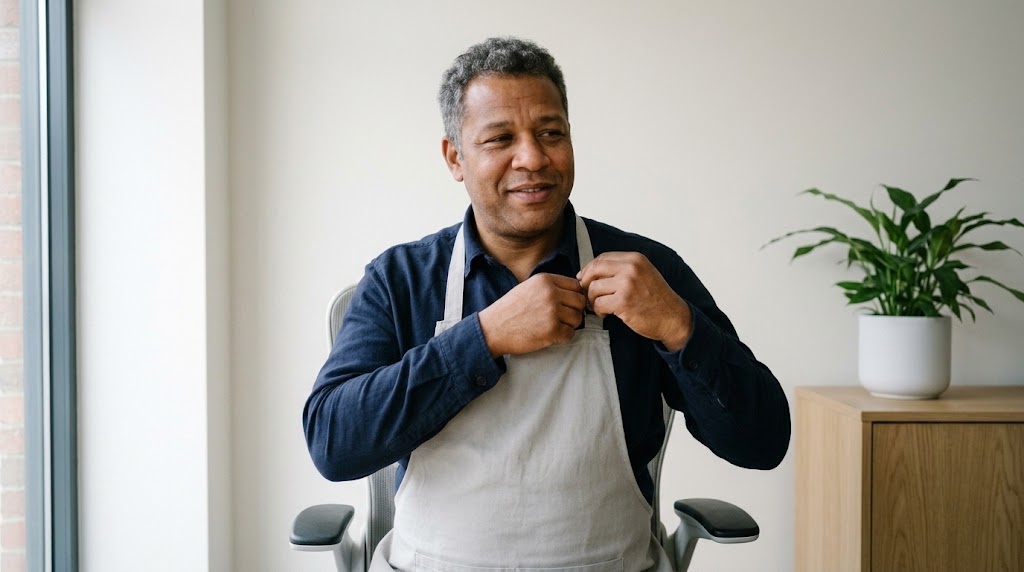
№ 09Photography
The headshot your colleague sends back
AI headshots that look real still need the person’s approval. Use their feedback to make a team portrait they would choose for their own LinkedIn profile.
№ 10PhotographyPhoto essay
Make an AI photo essay from one imaginary roll of 36 frames. Spend the last wash at a fictional launderette, then edit your roll down to six.
Start outside the plate glass, where low sun cuts across the floor and a drum turns at the back. The wash gives you a clock. The edit below stops at five.
We like the finality of a finished roll. A near miss stays, and the edit has to work with the pictures available. David White’s account of Shoot 36 describes the photographic precedent. You use one fixed lens for a 36-exposure roll, then submit six photographs. Here, each submission spends one numbered slot. Stop at 36.
Give the essay a sentence to work towards: An ordinary room slowly gives up the signs that someone is still using it. The turning wash gives way to an empty drum. Different people pass through once each; the room holds the sequence together.
This is an AI-generated fictional photo essay. The people and belongings are imagined; the room has no real address. Our introduction to promptography gives the broader context.
Use Google Nano Banana 2.1, at 10 credits per run, for a full-roll budget of 36 × 10 = 360 credits. You can choose OpenAI GPT-Image 2.6 Sunburst, also 10 credits per run, for the same 360-credit total. Settle that choice before frame 01; changing models after a disappointment makes it easy to keep shopping for a picture.
The lower-cost roll uses FLUX.2 Klein 4B at 2 credits per run: 36 × 2 = 72 credits. These totals budget 36 one-image runs. Record actual debits separately. Any direction test must be one of the 36 prewritten shots.
The prompts ask for landscape 3:2. Keep your chosen output controls fixed. The Studio links prefill the prompts with automatic rewriting off. Check the selected model before submitting; a recorded model mismatch spends its slot but stays out of the edit.
Keep the room narrow, with a plate-glass front onto the street. From the entrance, three white front-loading machines sit in pale oak cabinetry along the left wall. A pale-blue upholstered bench runs opposite them. Put a pale oak folding table by the front window, with grey terrazzo reaching the cream back wall. Keep the steel-framed details and two healthy plants: one at the window, one at the back. Everything is clean and new.
Use one natural-colour grade with neutral whites and fine grain. A fixed 35mm viewpoint leaves enough room to locate a detail. The camera settings in the prompts describe a look. Let the light change: hard late-afternoon sun through frame 09, a passing shower in 10–13, clearing gold in 14–22, then blue hour through 29. Switch to the room’s ceiling light for 30–36. Keep it off before then.
Plan for the farthest machine to carry the last wash through to the empty drum. Ask for its round door to stay closed and flush until unloading in frame 20, then swing flat against the oak cabinet front. Specify a hinge at the left of its opening and keep the other two doors closed and flush. Keep the coat brown and the bag navy. The oat towel moves from the window table into the bag. Start from the written room description without a reference upload.
For your own location, Prompt Crafter can turn rough observations into a draft. Check its wording against what you want before freezing the list. The prompt-writing guide helps with phrasing; the photorealistic prompt examples offer subjects for another roll.
Here is the shot list written before the roll. It records the intended scenes.
Frames 09 and 29 were meant to show the middle seat occupied and then empty. In 09, the customer sits at the window end; 29 shows the empty middle seat. The planned match is lost. Frames 16 and 22 follow the wash into an empty drum. Run these examples at their numbered places, then choose from the complete roll.
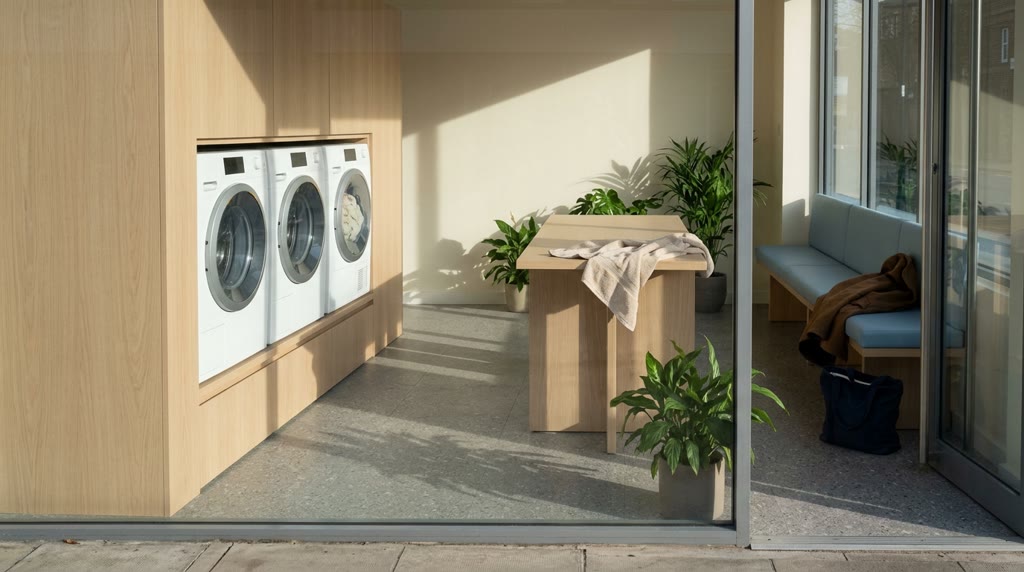
Frame 01 from the roll.
Documentary photograph. Wide shot from the pavement outside, looking through the laundry's plate-glass front into the narrow room. Three white front-loading machines sit flush in one continuous pale oak cabinet along the left wall as seen from the entrance; their round doors are closed, the farthest showing pale washing behind its glass. A pale-blue upholstered bench runs opposite. A pale oak folding table stands just inside the window; grey terrazzo runs to the cream back wall. Healthy plants stand by the front window and at the back. The oat towel lies unfolded on the window table. A brown coat rests at the window end of the bench above a navy bag. Frame obliquely through the glass, past the folding table, with a steel window mullion at the right edge. Low late-afternoon sun rakes through the plate-glass front, casting long hard-edged shadows across the terrazzo; natural colour, muted oak and blue, white machine fronts brightest. Nobody is in view. Everything clean and new. Unposed, matter-of-fact mood. Landscape 3:2, neutral whites and fine grain, straight verticals. Nikon D850 with Nikkor 24-70mm f/2.8E ED VR at 35mm, f/8, 1/250 second.
Check: A reflection that floats inside the room breaks the view through the window.
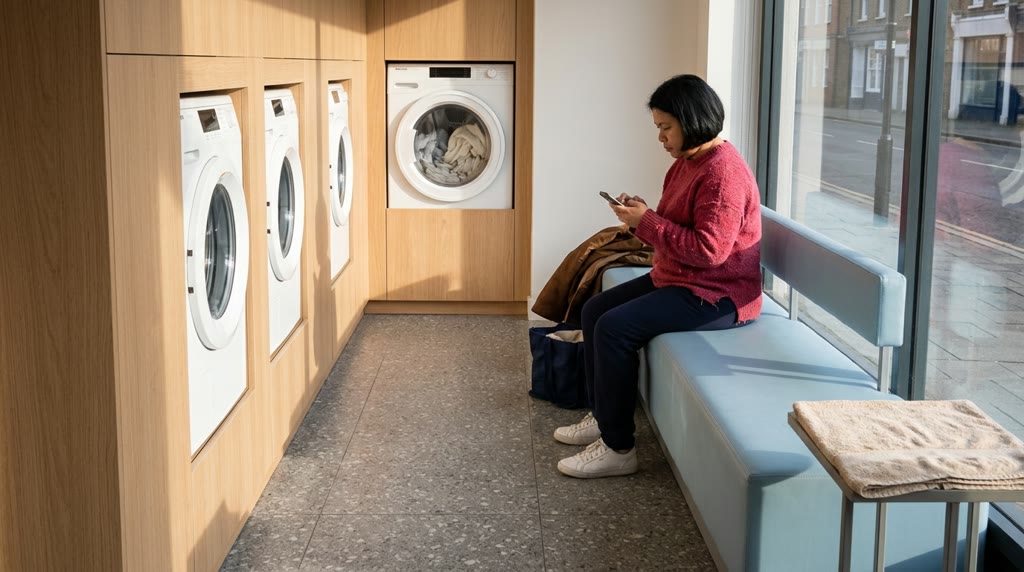
Frame 09 from the roll. A fourth machine appears in the back wall.
Documentary photograph. Full shot of a stocky 42-year-old woman with light-brown skin and a short black bob, wearing a raspberry knit jumper, navy trousers and white trainers, scrolling on her phone on the middle seat of the pale-blue upholstered bench. In a narrow contemporary self-service laundry with a plate-glass street front, white machines in one continuous pale oak cabinet line the left wall as seen from the entrance, opposite a pale-blue upholstered bench. The oat towel lies unfolded on the window table. A brown coat rests at the window end of the bench above a navy bag. All three round machine doors are closed and flush in the oak cabinetry, pale washing turning behind the farthest one; nothing projects from the cabinet fronts. Frame side-on from the aisle, eyes on her screen, with the seat's front seam clearly visible, grey terrazzo below and the window table at the edge. Low late-afternoon sun rakes through the plate-glass front, casting long hard-edged shadows; natural colour, raspberry against pale blue, the jumper the strongest colour and sunlit upholstery brightest. The customer is unaware of the camera. Everything clean and new. Unposed, matter-of-fact mood. Landscape 3:2, neutral whites and fine grain, straight verticals. Nikon D850 with Nikkor 24-70mm f/2.8E ED VR at 35mm, f/8, 1/250 second.
Check: She scrolls her phone, but sits at the window end of the bench. Check the seat as well as the action.
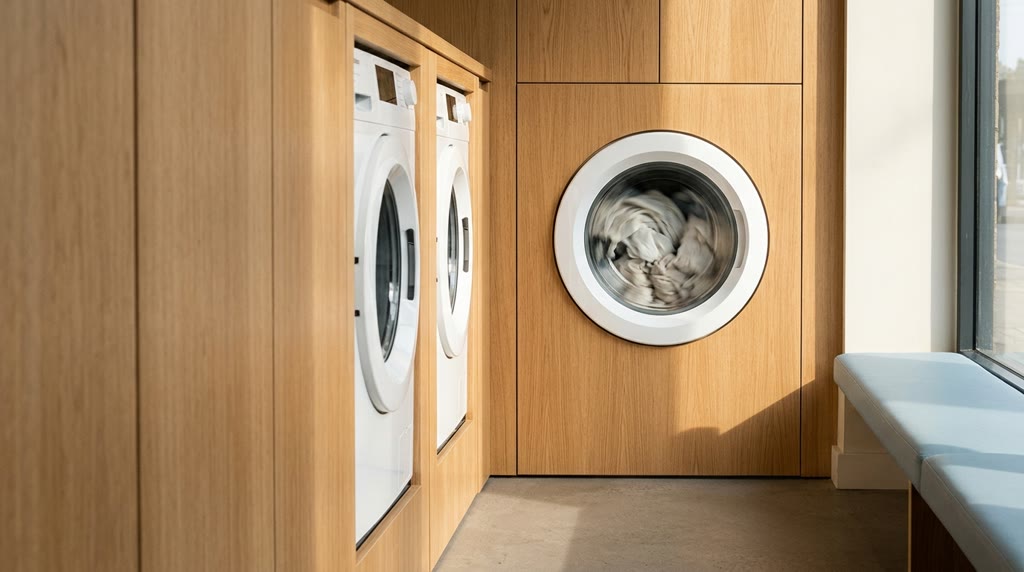
Frame 16 from the roll. The farthest machine sits in a cabinet on the back wall.
Documentary photograph. Close-up of pale washing turning behind the closed glass door of the farthest white machine. In a narrow contemporary self-service laundry with a plate-glass street front, white machines in one continuous pale oak cabinet line the left wall as seen from the entrance, opposite a pale-blue upholstered bench. All three round machine doors are closed and flush in the oak cabinetry, pale washing turning behind the farthest one; nothing projects from the cabinet fronts. Frame squarely from the aisle with the full circular rim and a strip of pale oak cabinetry visible; motion softens only the cloth behind the glass. Clearing golden sunlight enters through the plate-glass front, casting long defined shadows; natural colour, pale cotton and warm oak, the white door rim brightest. Nobody is in view. Everything clean and new. Unposed, matter-of-fact mood. Landscape 3:2, neutral whites and fine grain, straight verticals. Nikon D850 with Nikkor 24-70mm f/2.8E ED VR at 35mm, f/8, 1/30 second.
Check: Blur belongs to the washing; the rim and glass need to hold their shape.
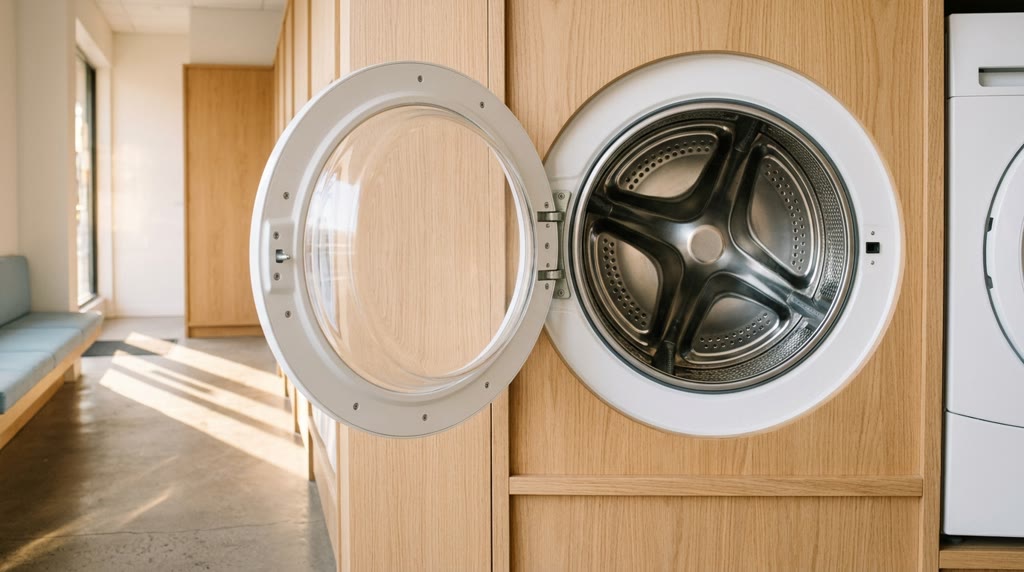
Frame 22 from the roll.
Documentary photograph. Close-up of the empty farthest drum through its open white door in the pale oak machine cabinet. In a narrow contemporary self-service laundry with a plate-glass street front, white machines in one continuous pale oak cabinet line the left wall as seen from the entrance, opposite a pale-blue upholstered bench. The farthest machine's round door is open, hinged on the left of its opening and swung flat against the oak cabinet front; the other two doors are closed and flush. Nothing floats in the aisle. Frame from the aisle with the circular mouth central and the open door flat against the cabinet front; include a strip of cabinetry to locate the drum in the room. Clearing golden sunlight enters through the plate-glass front, casting long defined shadows; natural colour, neutral steel and warm oak, the white rim brightest. Nobody is in view. Everything clean and new. Unposed, matter-of-fact mood. Landscape 3:2, neutral whites and fine grain, straight verticals. Nikon D850 with Nikkor 24-70mm f/2.8E ED VR at 35mm, f/5.6, 1/125 second.
Check: Look for an attached hinge and a drum with depth beyond its rim.
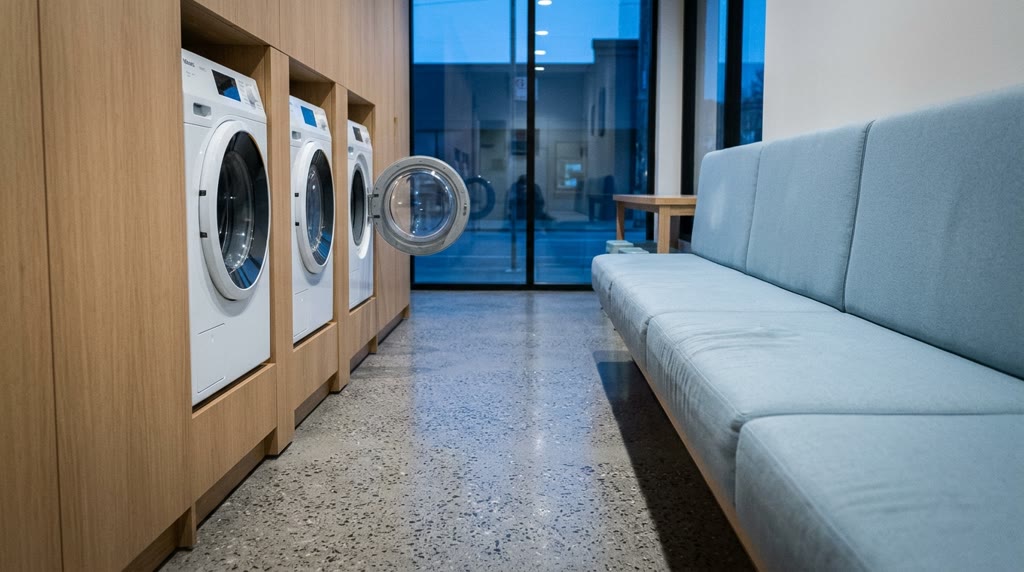
Frame 29 from the roll. The open door floats beside the third machine.
Documentary photograph. Full shot of the empty middle seat of the pale-blue upholstered bench opposite the machines. In a narrow contemporary self-service laundry with a plate-glass street front, white machines in one continuous pale oak cabinet line the left wall as seen from the entrance, opposite a pale-blue upholstered bench. The table and bench are clear, with the belongings removed. The farthest drum is empty. The farthest machine's round door is open, hinged on the left of its opening and swung flat against the oak cabinet front; the other two doors are closed and flush. Nothing floats in the aisle. Frame side-on from the aisle, the seat's front seam clearly visible, with grey terrazzo below and the pale oak window table at the edge. Blue-hour skylight through the plate-glass front gives soft cool shadows; natural colour, pale blue and oak, the blue window glow brightest. Nobody is in view. Everything clean and new. Unposed, matter-of-fact mood. Landscape 3:2, neutral whites and fine grain, straight verticals. Nikon D850 with Nikkor 24-70mm f/2.8E ED VR at 35mm, f/2.8, 1/60 second.
Check: The middle seat’s seam reads at blue hour, but frame 09 puts the customer elsewhere.
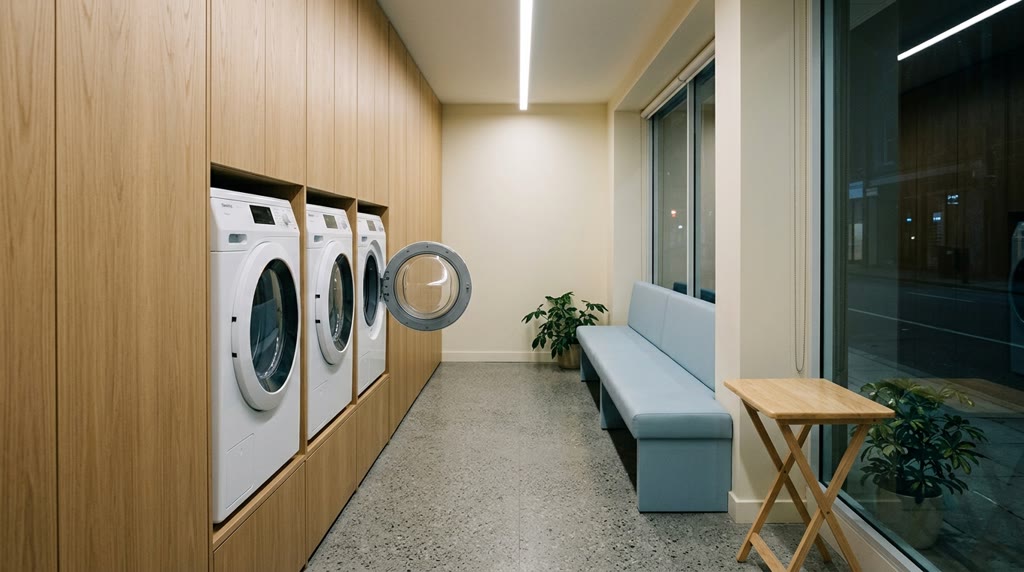
Frame 36 from the roll. The open door floats beside the farthest machine.
Documentary photograph. Wide shot of the empty laundry from its doorway, with one open drum at the back. The narrow room has a plate-glass street front, three white front-loading machines in one continuous pale oak cabinet on the left as seen from the entrance, and a pale-blue upholstered bench opposite. A pale oak folding table stands by the front window; grey terrazzo runs to the cream back wall. Healthy plants stand by the front window and at the back. The table and bench are clear, with the belongings removed. The farthest drum is empty. The farthest machine's round door is open, hinged on the left of its opening and swung flat against the oak cabinet front; the other two doors are closed and flush. Nothing floats in the aisle. Frame the grey terrazzo aisle towards the farthest machine, white fronts and pale oak cabinetry on the left, the vacant pale-blue bench opposite and the clear window table beside the camera. The laundry’s single diffused ceiling strip lights the room at night, casting soft shadows while the street is dark; natural colour, pale blue and warm oak, the white machine fronts brightest. Nobody is in view. Everything clean and new. Unposed, matter-of-fact mood. Landscape 3:2, neutral whites and fine grain, straight verticals. Nikon D850 with Nikkor 24-70mm f/2.8E ED VR at 35mm, f/4, 1/60 second.
Check: Compare with frame 02: the furniture and both plants should remain after the belongings leave.
The difficult moment is the almost-right picture. Leave its fault visible in the roll. Each frozen prompt gets one submission for one image; a miss spends the slot, and an error leaves it empty. Later prompts keep their original jobs. There are no replacement attempts.
A manual ledger needs one row per slot: the planned shot and exact prompt, followed by the returned filename, outcome, executed model and actual debit. Save the numbered originals, including the failures. After slot 36, work with those files. Keep their crops and colour unchanged for this exercise, without generative repairs. A missing turning point may mean a shorter edit.
The roll was shot in Google Flow with Google Nano Banana 2.1 on 10 November 2026. All 36 prompts were submitted once in order, with one image per slot. Every slot returned an image; none was retried or replaced. Flow has no 3:2 option, so the frames are 16:9. No cgfaces credits were spent; the same roll in the Studio would cost 360 credits.
Follow the bench and table through the views to check the room holds together. Then shortlist up to twelve frames, writing “This image adds…” beside each. Two views of a closed machine may be competing for one place.
Bjorn Petersen’s guide to editing and sequencing discusses how pacing changes the experience of individual pictures. Our five-frame edit is 01 → 13 → 16 → 20 → 22. Try it without captions, then remove each selection in turn to see what is lost.
Frame 13 replaces 09, which adds a fourth machine and moves the customer to the window end of the bench. Frame 16 keeps a fault of its own: the farthest machine moves to the back wall. The alternative wash view, 19, has the same fault plus a fourth machine.
AI-generated fictional photo essay
Frame 01 brings you in through the glass with the wash already turning and the sun low. The room matches the written contract.
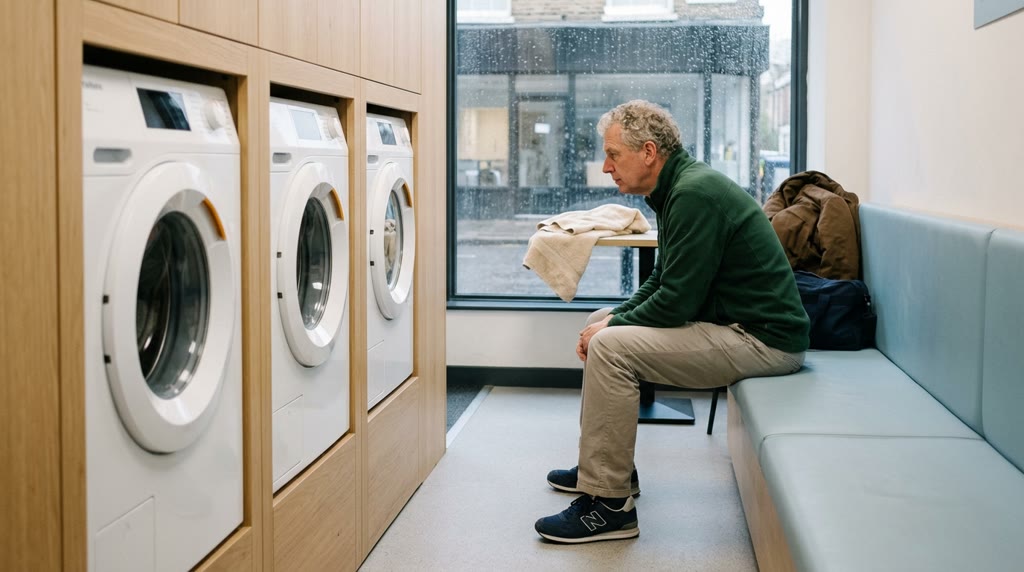
Frame 13 gives the wait a human scale during the shower. The man in the forest-green jacket looks down towards the towel and table more than at the drum.
Frame 16 brings you close to the wash after the wait in 13. The cloth moves while the rim and glass stay sharp, though the machine sits in the back wall.
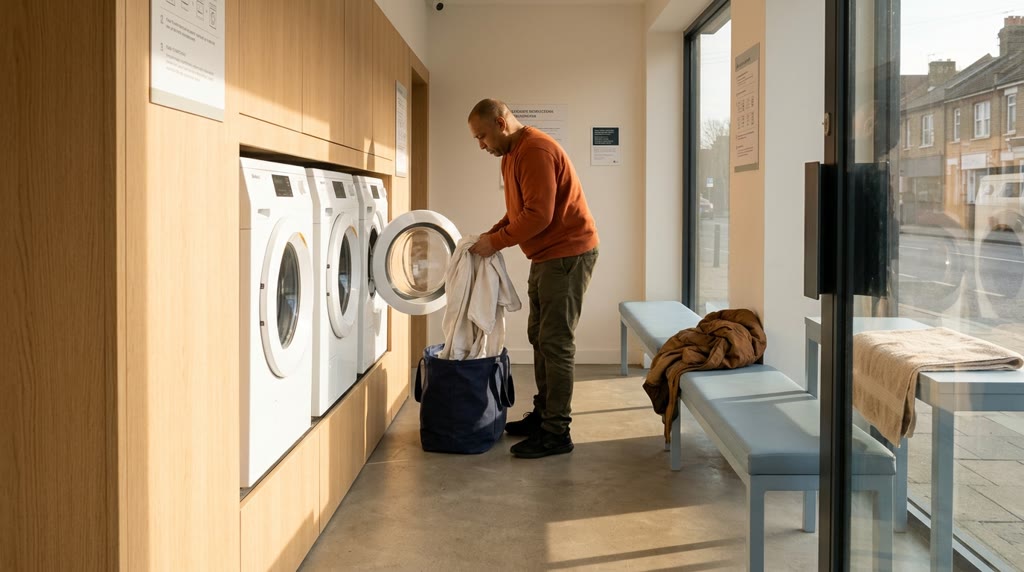
Frame 20 connects the turning wash to the empty drum as the man lifts the washing into the navy bag. Three machines remain, and the open door hangs on its hinge.
Frame 22 ends on the empty steel drum after the unloading. The door is attached on the left; the drum has depth beyond its rim.
Frame 36 is the tempting rejection. The room is clean, with the bench and both plants in place under the requested night light. The open door floats beside its machine. That fault cuts the planned ending from the edit.
The open drum in 22 ends this edit with a small task left behind. Frame 23 still has an attached door, though its light reads as daylight. Every frame from 24 to 36 carries the floating door, including the doorway view in 36 and the exterior in 35. The sequence stops before blue hour.
For another roll, a workshop bench after the last repair could be enough. Write down what changes there, then give it 36 frames before opening the Studio.
№ 10 · PhotographyAll stories
№ 09Photography
AI headshots that look real still need the person’s approval. Use their feedback to make a team portrait they would choose for their own LinkedIn profile.
№ 06Photography
AI product photography for ecommerce should keep your cup's wonky rim. Build a shop photo set around the real object, with prompts and close visual checks.
№ 04Photography
To make AI images look more natural, give people a task. Start with a mechanic adjusting a brake and a runner shaking rain from her cuff.